
Achieving the flawless, translucent look of K-beauty “glass skin” requires a meticulous morning routine. However, many skincare enthusiasts encounter a frustrating obstacle: that heartbreaking moment when layers of carefully applied products begin to ball up, creating tiny, eraser-like shavings across the face the moment foundation is blended. This phenomenon, scientifically known as product pilling, compromises the structural integrity of your makeup base and leads to a patchy, uneven finish.
If you are tired of watching high-quality sunscreens disrupt your morning cosmetic application, understanding the underlying formulation chemistry is the key to a smooth canvas. Eliminating this texture issue requires evaluating how topical layers interact with your specific skin physiology.
1. Why Your Sunscreen is Pilling Under Makeup: The Science of Cosmetic Incompatibility
To solve the mystery of why your sunscreen is pilling under makeup, you must look past aesthetic packaging and analyze the ingredient deck. Pilling is rarely a fault of a single product; rather, it is a structural failure caused by chemical incompatibility and poor molecular bonding between successive layers.
The Hydrophobic Clash: Silicones vs. Water
A primary reason why your sunscreen is pilling under makeup is the conflict between water-based hydration and heavy silicone seals. Many western moisturizers rely on high concentrations of water (Aqua) and humectants like glycerin to plump the skin. Conversely, traditional sunscreens and smoothing primers often utilize heavy, high-molecular-weight silicones—such as Dimethicone, Cyclopentasiloxane, or Polysilicone-11—to create a velvety, blurred barrier that seals in moisture.
Because silicones are inherently hydrophobic (water-repelling), applying a silicone-dense sunscreen over a wet, water-based moisturizer creates an unstable boundary layer. Instead of fusing with the skin, the silicone shield floats on top. When you introduce the mechanical friction of a makeup brush or a cushion puff, this unbonded film tears, rolls up, and pills instantly.
The Coagulation of Film-Formers
Sunscreen formulations require specialized synthetic polymers and film-forming agents to ensure that UV filters remain evenly distributed and water-resistant on the skin. However, these volatile polymers can destabilize when they interact with excess surface lipids.
The exact physiological cause varies significantly depending on your specific skin type:
- For Dehydrated Oily Skin: When your skin barrier lacks water but overproduces sebum, the excess lipids mix with the unabsorbed film-formers of your sunscreen. This triggers an emulsification process on the surface, causing the SPF to destabilize and clump into visible debris when mixed with pigments from your foundation.
- For Dry and Flaky Skin: When the skin lacks sufficient lipids, it rapidly saps the water content from your moisturizer, leaving the sunscreen’s polymers stranded on dry, loose corneocytes (dead skin cells). The friction of cosmetic tools lifts these dry flakes, lifting the sunscreen film along with them.
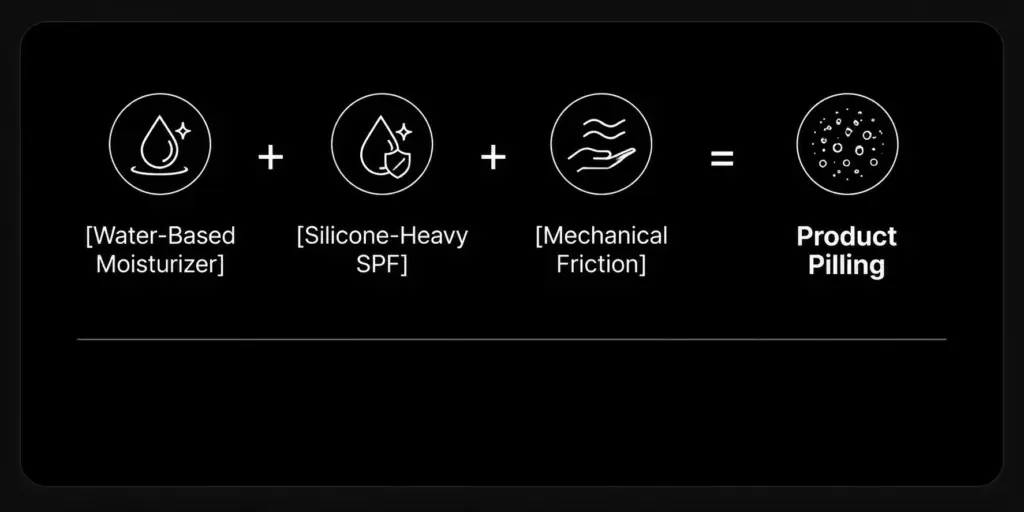
To sum it up in a simple chemical equation, as illustrated in image_3eb6c1.png, combining a Water-Based Moisturizer with a Silicone-Heavy SPF and adding Mechanical Friction inevitably equals Product Pilling.
2. The K-Beauty Solution: Reformulating Your Base Layer
The modern K-beauty approach to sun protection focuses on ultra-lightweight texturizing technology that prioritizes layer compatibility, effectively mitigating the common issues that cause product clumping.
Transition to Advanced Aqueous Sun Serums
To permanently resolve why your sunscreen is pilling under makeup, swap out dense, emollient sun creams for advanced K-beauty formulations classified as Sun Sciences, Sun Serums, or Watery Sun Gels. These innovative formulas encapsulate chemical UV filters within an ultra-lightweight aquagel network. Upon application, the water-gel vehicle breaks apart, allowing the hydration to sink into the epidermis while leaving behind an incredibly thin, weightless, and non-hydrophobic protective film that acts like a primer magnet for cushion foundations.
Decode the Ingredient Placement
When curating a pill-free routine, aim for formulation harmony. Check the first five ingredients on the back of both your moisturizer and your daily sunscreen. If your prep routine relies on a lightweight, water-dominant gel cream, pair it with an equally fluid, water-first sun essence. Keep heavy silicone-based formulas restricted to the very final steps of your routine, or reserve them for dedicated makeup primers rather than your daily sun care.
Differentiate Between Mineral and Chemical Filters
The type of UV filter you choose plays a massive role in how your makeup sits. Physical or mineral sunscreens utilize solid particulate powders—specifically Titanium Dioxide and Zinc Oxide—to reflect UV rays. These dense mineral powders sit physically on top of the skin barrier. When layered beneath a heavy foundation, the physical particles create massive friction, making mineral sunscreens highly prone to pilling.
To explore the chemical structures and absorption differences between these two types of protective shields in greater detail, you can read our comprehensive breakdown on Physical vs. Chemical Sunscreen.
3. Professional Application Tactics for a Texture-Free Finish
Fixing a disruptive skincare routine requires adjusting not just what you apply, but how you apply it. Embracing the professional “Wait & Pat” methodology keeps your defensive layers completely intact.
Implement the 5-Minute Buffer Rule
Never rush your sun protection. After completing your hydrating steps, allow three to five minutes for the volatile solvents in your moisturizer to evaporate fully. Your skin should feel plump, smooth, and dry to the touch—not wet or tacky—before you apply your sunscreen. This brief pause allows the skincare to stabilize, preventing cross-contamination between formulas.
Shift from Rubbing to Patting
Aggressive rubbing motions create micro-friction that breaks down the delicate polymer network of your sunscreen before it has a chance to set. Instead, dot your sun essence evenly across your face and use the flats of your fingers or clean palms to gently press and pat the formula into the skin. This setting technique mimics the application of a professional makeup artist and ensures an unbroken shield of UV protection.
Re-evaluate Your Makeup Tools
Stiff, dense buffing brushes micro-exfoliate the stratum corneum, lifting up both dead skin cells and your newly applied SPF layer. To maintain total skin harmony, switch to a damp, bouncy microfiber sponge or a traditional K-beauty rubycell cushion puff. If you want to master the art of applying a smooth, airbrushed second-skin layer without disrupting your protective SPF film beneath, follow our complete K-Beauty Cushion Foundation Guide.
The Professional Emergency Fix: If you spot minor pilling while applying your foundation, do not panic and wash your face. Lightly mist your skin with a soothing facial spray containing centella asiatica or ceramides. Take a damp beauty sponge and firmly press the pilled areas. The fine mist re-emulsifies the surface layer, allowing the displaced polymers to blend smoothly back into the skin without ruining your entire routine.
4. Optimal Nighttime Prep for Morning Success
A seamless morning cosmetic application begins with your evening skincare habits. Residual silicones, long-wear cosmetic pigments, and accumulated dead skin cells create an uneven surface texture that guarantees morning pilling.
Adopting a thorough double-cleansing method every evening—starting with a gentle cleansing oil to dissolve oil-soluble silicones, followed by a water-based foaming cleanser—leaves your pores completely clear. Integrating mild, non-stripping chemical exfoliants like PHAs (Polyhydroxy Acids) or LHAs (Lipo Hydroxy Acids) gently removes superficial flakes without irritating your barrier. Cultivating a smooth, clear skin texture at night allows your morning sunscreen to adhere flawlessly to the skin, completely eliminating the surface friction that triggers pilling.
To better understand how these synthetic cosmetic polymers interact with skin lipids on a clinical level, you can review the latest dermatological data hosted by the National Library of Medicine.
5. Elevate Your Daily Base
Overcoming a patchy foundation base requires understanding the fundamental chemistry of your vanity. By matching your product bases, switching to lightweight watery sun essences, and allowing each layer proper time to settle, you protect your skin from both UV rays and cosmetic frustration.
What sunscreen and foundation combination are you currently wearing? Let’s troubleshoot your daily routine and share your favorite pill-free Holy Grails in the comments below!
Disclaimer: I am a skincare enthusiast sharing the results of my personal trial-and-error journey. This content is intended for educational purposes and should not replace professional medical advice from a certified dermatologist.