
You wake up, meticulously layer your hydrating serums, apply your sunblock, and step out into the summer heat. By 2 PM, the horror show begins: your t-zone is a greasy midday slick, your eyes are stinging with a painful chemical burn from your sweat, and tiny, angry red bumps are starting to pop up along your jawline. To make matters worse, your expensive foundation is pilling and caking into a patchy, white-cast disaster. We’ve all been there, trying to lock down that flawless, translucent Glass Skin finish, only to end up with a compromised skin barrier and an emergency breakout.
Navigating the world of sun protection when you have sensitive, dehydrated oily skin—famously known in K-Beauty as Subuji skin—is an absolute tightrope walk. In my early 20s, after completely stripping my skin barrier with aggressive acne treatments, I slathered on heavy, thick zinc oxide pastes to protect my raw face. The result? It completely suffocated my pores, trapped sebum underneath, and triggered a painful cystic acne flare-up that took months to heal.
That skincare heartbreak taught me a crucial lesson: choosing the wrong protective barrier is a guaranteed way to cause severe structural damage to your skin. To block UV rays effectively without short-circuiting your tone, you need a precise biological understanding of the Physical vs Chemical Sunscreen dilemma. Let’s audit the exact molecular science behind these two protective shields so you can choose the perfect daily match for your Subuji profile.
1. The Problem: The High-Friction Battleground of Dehydrated Oily Skin
The primary struggle for the sensitive Subuji community is balance. Your skin is screaming for hydration on the inside, yet it produces excess sebum on the surface to compensate for a damaged lipid barrier. Traditional, uncalibrated sunscreens are rarely formulated for this unique duality; they either focus on creating an ultra-heavy surface tarp or use harsh, volatile solvents to create a artificial matte finish.
When you apply a generic, heavy mineral sunblock, the thick particles of zinc oxide and titanium dioxide act like a physical blanket. For oily zones, this blanket traps heat and natural lipids, turning your pores into a breeding ground for acne-causing acne. On the flip side, running away from mineral pastes often leads people straight to traditional chemical filters. While these organic formulas are beautifully transparent and fluid-like, their active ingredients can destabilize when exposed to high heat and UV radiation. As these compounds degrade on your face, they release thermal energy that causes a stinging sensation upon contact with sweat, triggering chronic micro-inflammation and facial flushing.
The result isn’t just premature fine lines; it’s a loss of structural bounce. The skin begins to look slightly deflated, loses its translucent radiance, and struggles to retain moisture. In the skincare community, we often call this sluggish skin—a state of chronic skin fatigue where your face simply refuses to bounce back after a long day. If your daily SPF currently flakes, turns cakey under your makeup wear, or causes your eyes to water, your protective coating is failing its daily operational load.
2. The Explanation: The Molecular Science of Mineral and Organic Filters
To master your morning skincare calendar, we must inspect the distinct defensive behaviors of Physical vs Chemical Sunscreen. In advanced K-Beauty formulation science, UV efficiency is calculated by how cleanly a protective layer manages incoming solar radiation without destabilizing your underlying cellular infrastructure.
Physical sunscreens, or mineral shields, rely on inorganic mineral compounds that sit directly on top of the stratum corneum, which is the outermost layer of the skin matrix. They act as a physical reflective mirror, mechanically bouncing both UVA and UVB rays away from your face before they can penetrate the epidermis. Because these minerals do not absorb into the skin cells, they possess incredibly high biocompatibility, making them the ultimate gold standard for hyper-reactive, raw, or post-procedure skin profiles. However, the inherent density of large mineral molecules is what naturally creates that dreaded, chalky white cast and heavy feel on oily skin textures.
Conversely, chemical sunscreens, or organic shields, utilize carbon-based chemical compounds like Avobenzone, Octisalate, and next-generation synthetic filters. Instead of sitting on top as a reflective tarp, these organic molecules seamlessly absorb into the upper layers of the epidermis, acting as an energy converter.
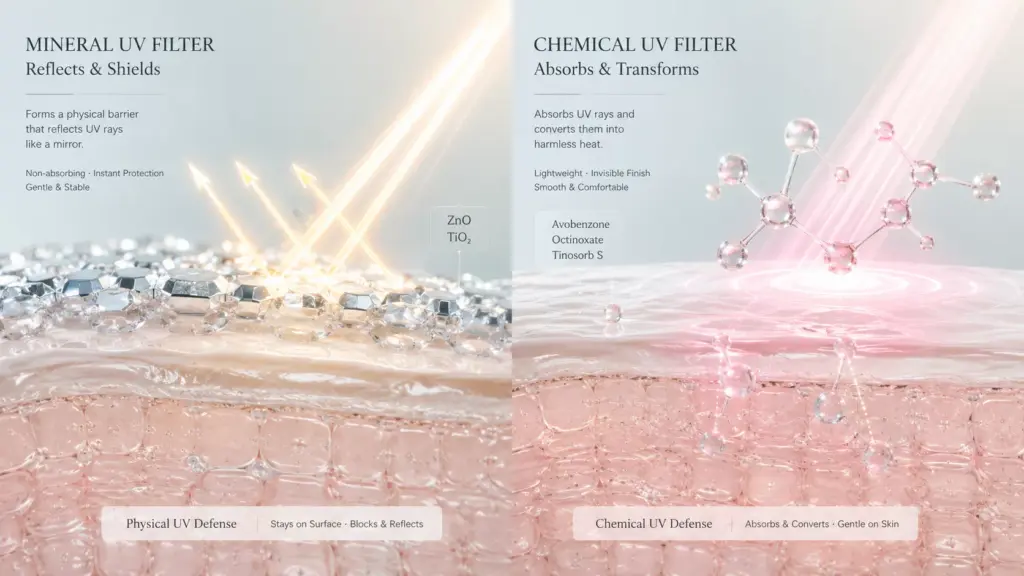
When UV radiation hits your skin, these chemical filters absorb the light and transform it into a harmless ambient heat, which is then released from the body. This mechanism allows chemical formulas to achieve an ultra-lightweight, transparent, and fluid-like essence texture that sits beautifully under daily makeup wear without causing any pilling. However, the chemical reaction itself can sometimes trigger heat-induced redness and allergic contact dermatitis on a deeply compromised skin barrier.
To see the exact safety metrics and chemical compound classifications of these active agents, you can verify this authoritative PubMed Clinical Analysis on Mineral and Organic UV Filters Safety which details the real dermal absorption thresholds and systemic safety profiles of modern sun filters. Understanding this data is the fastest way to stop the breakout cycle. For a practical application of how to safely cleanse these resilient, water-resistant shields from your skin at night without stripping your precious lipid mortar, make sure to read our comprehensive guide on the Best Cleansing Oil for Sensitive Skin to prevent standard cosmetic setbacks and stubborn clogged pores.
3. The Solution: Sourcing the Perfect Modern K-Beauty Hybrid Shield
Choosing between these defensive mechanisms in the Physical vs Chemical Sunscreen dilemma isn’t about picking a single winner; it is about finding smart formulation synergy. For a long time, consumers were forced to choose between the heavy safety of minerals or the elegant, irritating lightness of chemical fluids.
Fortunately, modern K-Beauty engineering has completely disrupted the market by developing advanced hybrid sunscreens. These innovative formulas utilize micronized, nano-sized particles of Zinc Oxide coated in lightweight organic fluid esters. This hybrid approach allows you to experience the soothing, non-irritating, deflective safety of a physical shield, combined with the zero-friction, transparent, and quick-absorbing texture of a chemical fluid. It keeps your skin cool throughout the day while ensuring your pores stay completely clear.
This breakthrough is exactly why modern hybrid formulas are shifting away from traditional sunblocks and leaning into what the community calls sun serums—delivering a weightless, dewy finish that acts more like a high-end primer than a heavy protective layer. To successfully implement this into your daily regimen, always look for watery gel-essences or fluid milks that explicitly state they are non-comedogenic and oil-free.

Furthermore, never force a high-performance active routine onto an uncalibrated base. Always apply your sun protection as the final step of your morning routine, giving your active treatments plenty of time to absorb. By mastering this selection technique, you build the perfect environmental barrier to protect your biological investment, especially after accelerating your cellular turnover with high-performance remodeling components like the ones we audited in our K-Beauty Peptides Benefits Glass Skin Guide.
4. Curated FAQ: Managing Your Daily UV Shield Tolerances
Will mineral sunscreens always leave a heavy white cast on my skin? Not with modern K-Beauty engineering. Today’s advanced formulations utilize micronized or nano-sized mineral particles that spread evenly across your skin architecture, giving you a completely transparent, light-reflective finish without losing any of their mechanical deflective power. However, if you have an ultra-reactive skin chassis, always opt for fragrance-free mineral shields and execute a 24-hour patch test behind your ear to safely verify your tolerance threshold before full application.
Can I layer chemical sunscreen right after applying my active serums? Yes, absolutely, but timing is everything. You must give your hydrating serums and active treatments at least 60 seconds to fully sink into the skin matrix first. If you apply a fluid chemical sunscreen onto a wet, unabsorbed base, you will dilute the filters, cause severe ingredient interference, and guarantee that your daily makeup will pill and cake by midday.
How often do I realistically need to reapply my physical or chemical shield? Under direct sun exposure, both physical and chemical filters break down their operational tolerance within 2 hours due to UV degradation, sweat, and natural sebum production. For consistent glass skin maintenance without ruining your makeup, a lightweight, non-greasy K-beauty sun stick is your ultimate holy grail companion for quick, weightless touch-ups on the go.
5. The Final Verdict: Designing Your Personal UV Coating Blueprint
In conclusion, the ultimate winner of the Physical vs Chemical Sunscreen audit depends entirely on your skin barrier’s current tolerance threshold. If your skin is currently raw, highly reactive, stinging from basic washing steps, and prone to severe redness, a pure physical mineral shield is your ultimate safe savior. It provides a non-combustible, soothing wall of protection that allows your skin to heal in peace.
On the other hand, if your skin barrier is healthy and you are primarily looking for a seamless, weightless, and invisible base that sits perfectly under your daily cosmetics without creating a greasy midday slick, a modern chemical fluid or a hybrid essence is your primary choice. Stop punishing your delicate skin with heavy, clogging products that cause chronic skin fatigue. Use the precision of K-Beauty ingredient science to physically protect your glow and secure a healthy, resilient skin infrastructure from within!
Disclaimer: The information provided on KBeautyExplained is intended solely for educational, informational, and editorial purposes regarding K-Beauty ingredient science and sun protection. This content is not a substitute for professional medical advice, clinical diagnosis, or dermatological treatment. Always consult with a board-certified dermatologist or qualified healthcare provider before introducing new active ingredients into your routine or addressing chronic skin conditions. Reliance on any information provided on this platform is strictly at your own discretion and risk.