
Achieving that coveted, lit-from-within “Glass Skin” clarity isn’t just about layering the trendiest aesthetic products; it requires an intentional approach to your skin’s foundational hydration. Many women in their 20s and 30s find themselves stuck in a frustrating cycle—dealing with an oily T-zone while experiencing dry, flaky patches that make makeup look cakey by noon.
If you are dealing with a dull, shifting complexion this season, you are likely missing a vital element in your routine. True, lasting radiance comes down to understanding the structural mechanics of your skin, and maximizing the targeted Hyaluronic Acid Benefits for Skin is the ultimate key to stabilizing your protective barrier.
The Invisible Culprit: Why Your K-Beauty Routine Is Flaking
Many skincare enthusiasts notice that their complexion suddenly turns tight, sensitized, or unusually greasy during seasonal shifts. This is rarely a sudden change in genetics. Instead, it is a direct response to a compromised lipid matrix.
The Frustrating Cycle of Dehydration
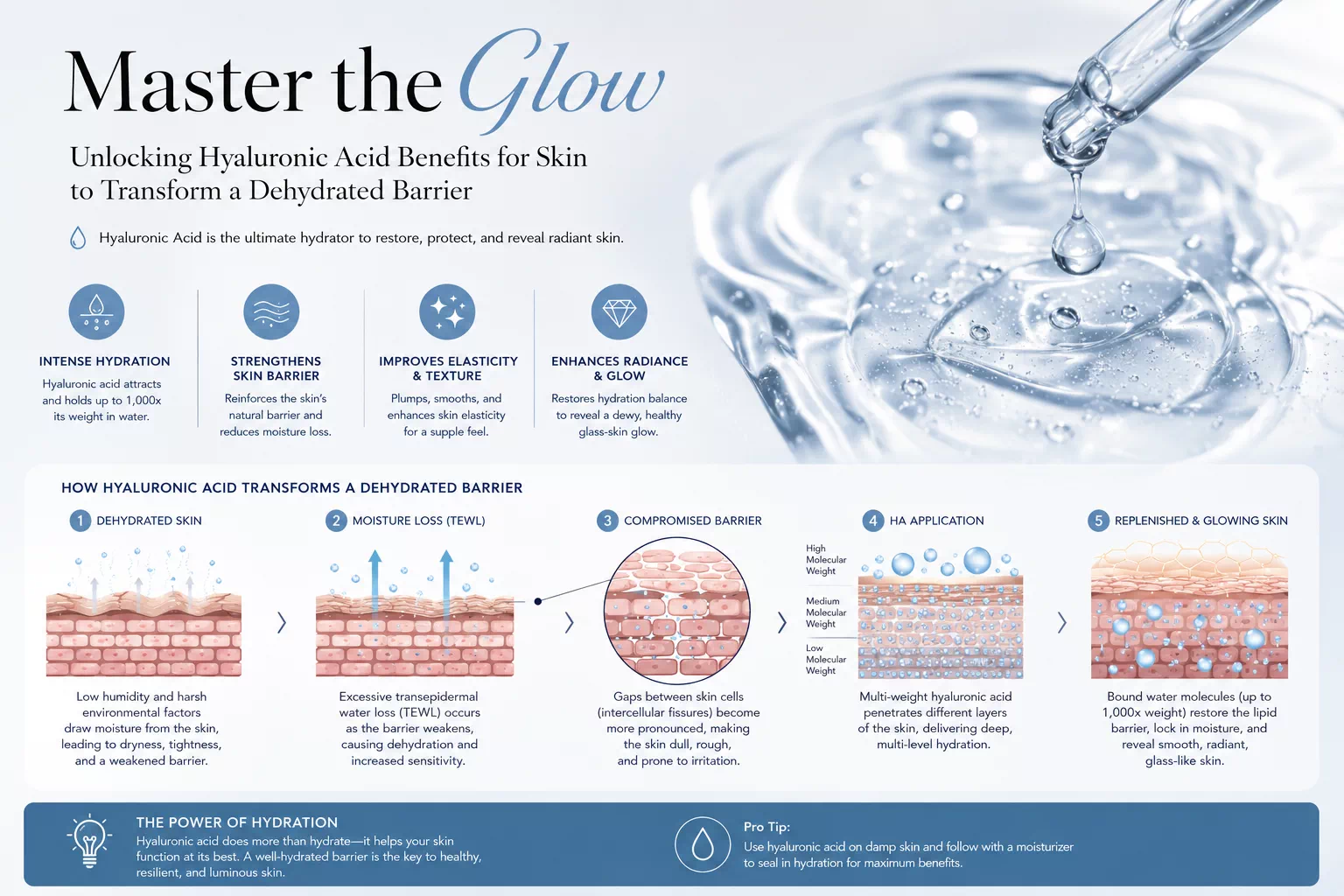
When the weather transitions, the drop in ambient humidity creates a phenomenon known as Transepidermal Water Loss (TEWL). Because dry air naturally draws moisture from where it is abundant, it actively pulls water out of your upper epidermal layers.
When your skin loses this critical internal hydration, it tries to compensate by producing excess sebum. This creates a confusing “surface oily, deeply dry” state. If you try to fix this by piling on heavy, rich oils, you often end up with clogged pores, texture bumps, and an even duller complexion.
A Personal Revelation from the Vanity
For a long time, I made the mistake of treating my oily surface with harsh, stripping cleansers while skipping deep humectants altogether. My skin barrier became so raw and irritated that even mild moisturizers caused a burning sensation.
The turning point came when I looked past the marketing buzzwords and focused on cellular hydration mechanics. I realized that my skin didn’t need heavy topical grease; it needed a dedicated biological magnet to bind water molecules directly to the cellular matrix. That is where mastering the right application methods comes in.
The Structural Science: Maximizing Hyaluronic Acid Benefits for Skin
To properly address a dehydrated barrier, it helps to look at the underlying science. Hyaluronic Acid (HA) is a naturally occurring glycosaminoglycan found within our extracellular matrix. It acts as the primary structural cushion that keeps our tissue plump, resilient, and youthful.
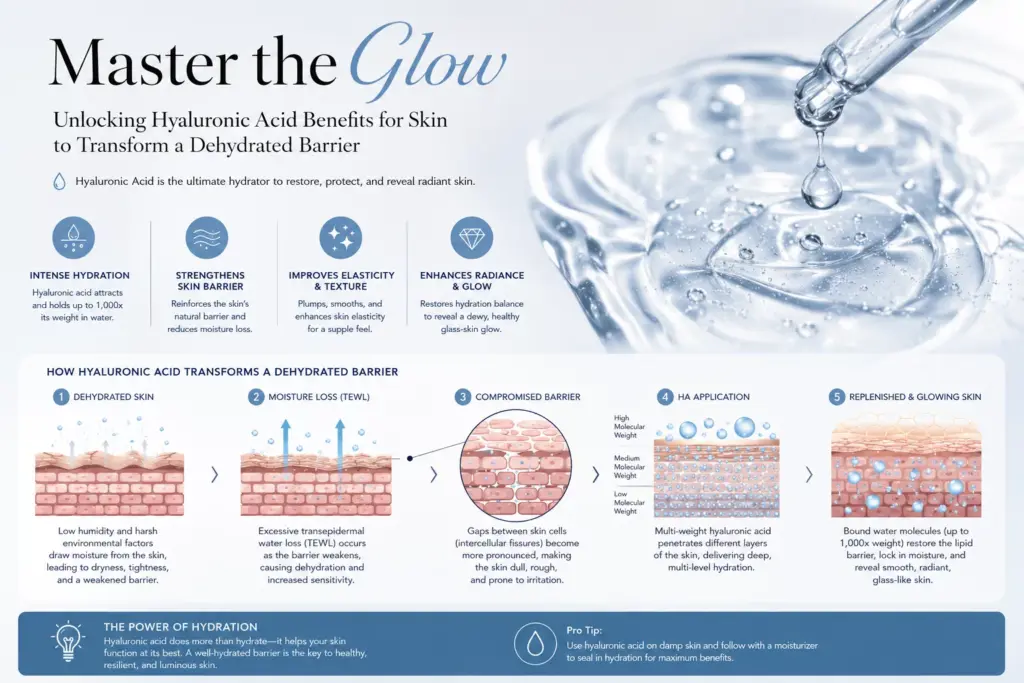
At a molecular level, HA functions as an incredibly powerful humectant. Its unique chemical structure allows a single molecule to attract and retain up to 1,000 times its own weight in water. When applied to the skin, it creates a flexible, breathable moisture network that draws water up from the deeper dermis and secures it within the stratum corneum.
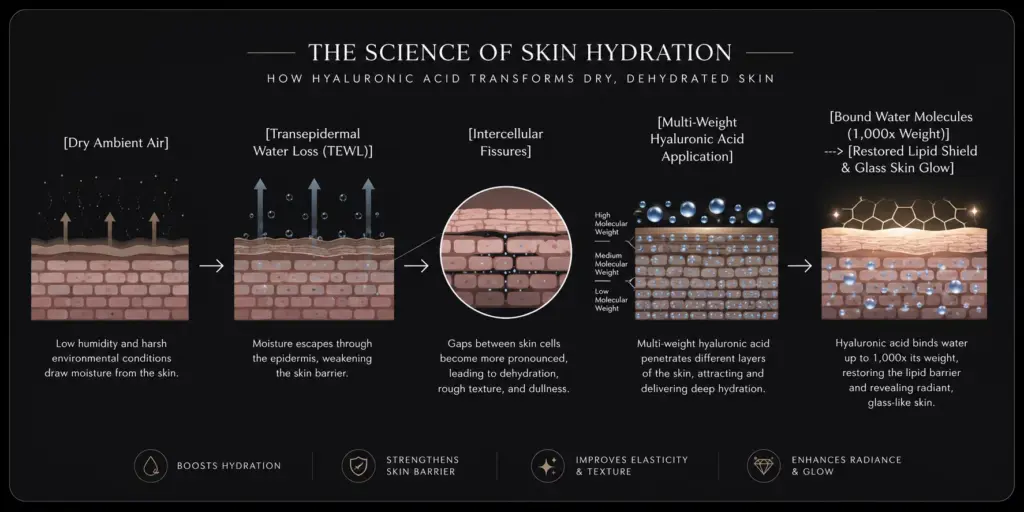
[Dry Ambient Air] —> [Transepidermal Water Loss (TEWL)] —> [Intercellular Fissures] │ [Multi-Weight Hyaluronic Acid Application] ◄────────────────────────────┘ │ ▼ [Bound Water Molecules (1,000x Weight)] —> [Restored Lipid Shield & Glass Skin Glow]According to a clinical review published in the National Center for Biotechnology Information (NCBI), topical hyaluronic acid formulations provide significant improvements in deep skin hydration and tissue elasticity.
The data demonstrates that utilizing a strategic mix of molecular weights allows the ingredient to inflate depleted intercellular spaces. This process smooths out fine lines and actively repairs micro-fissures from the inside out, making it an absolute necessity for maintaining a highly functional skin barrier.
The Strategic Solution: Layering Integration and Environmental Adjustments
Simply buying a standard hyaluronic acid serum will not solve the problem. To fully experience the Hyaluronic Acid Benefits for Skin, you must understand how to navigate different molecular weights and how to apply them correctly based on your environment.
1. Navigating the Molecular Weight Matrix
Hyaluronic acid comes in various molecular sizes, measured in Daltons (Da). High-molecular-weight HA sits comfortably on the outer surface, acting as a breathable shield that locks in existing water and gives an immediate plumping effect.
Meanwhile, low-molecular-weight HA features a tiny molecular structure that penetrates deep into the epidermis to repair structural damage. To get the best results, look for formulas labeled as a “Multi-Weight HA Complex.”
2. The Low-Humidity Protocol
Hyaluronic acid is an indiscriminate humectant, meaning it will pull water from the nearest available source. If you apply an HA serum to completely dry skin in an air-conditioned room, the molecule will actually draw water out of your deeper skin layers and let it evaporate into the dry air.
To prevent this “reverse hydration” effect, always apply your serum to damp skin immediately after cleansing or misting. Most importantly, always lock it in with an emollient moisturizer containing ceramides or squalane to seal the water molecules safely inside your skin matrix.
3. Synergizing Actives for Maximum Radiance
To accelerate your results, you can pair your HA serum with complementary K-Beauty active ingredients to target specific skin concerns:
| Skincare Synergy Pairings | Target Skin Concern | Primary Cellular Mechanism | Expected Clinical Result |
| Hyaluronic Acid + Niacinamide | Oily, Dehydrated Skin | Regulates excess sebum while stimulating natural ceramide synthesis. | Refined pores and a balanced, shine-free finish. |
| Hyaluronic Acid + Propolis Extract | Dull, Fatigued Complexion | Delivers rich flavonoids and vitamins to lock in deep moisture. | An instant, nutrient-dense “honey skin” glow. |
| Hyaluronic Acid + Centella Asiatica | Sensitive, Red Barrier | Calms surface irritation and accelerates cellular tissue repair. | Rapid redness reduction and a calmed skin barrier. |
The synergy matrix above outlines how combining hyaluronic acid with specific active ingredients can enhance your overall results. Without a hydrated base, your skin cannot fully absorb active ingredients like niacinamide or propolis.
By applying a multi-weight HA complex to a damp face first, you create an open pathway that allows these targeted treatments to penetrate deeper without causing surface irritation. This structured step ensures that your skin receives both deep hydration and protective nourishment.
A Cautious Approach: Incorporating High Concentrations Safely
When dealing with a compromised skin barrier, it is important to introduce new active products carefully. High-concentration serums can sometimes trigger unexpected sensitivity if your skin is already experiencing seasonal micro-cracks.
Before applying a new multi-weight HA complex to your face, perform a simple patch test on your inner forearm or jawline. Apply a few drops twice a day for 48 hours to monitor for any redness or tingling. For a deeper look at managing a sensitized skin barrier, you can read our detailed guide on the Centella Asiatica Recovery Routine to help keep your skin balanced.
Once your skin passes the patch test, introduce the serum into your daily routine. Apply it consistently to damp skin morning and night, and always finish with a broad-spectrum sunscreen during the day to protect your skin barrier.
A Resilient, Radiant Complexion
True, lasting skin health comes down to maintaining a strong moisture foundation. By understanding how to properly use hyaluronic acid, you can move past temporary skincare trends and build a reliable, research-backed daily routine.
Focus on applying your multi-weight formulas to damp skin, pairing them with supportive ingredients like niacinamide or centella asiatica, and sealing everything in with a high-quality ceramide moisturizer. Taking a consistent, mindful approach will keep your skin barrier resilient, smooth, and naturally glowing through every season.
Disclaimer: The information provided in this article is for educational and informational purposes only and should not be construed as professional medical advice, diagnosis, or treatment. Always consult with a board-certified dermatologist or qualified healthcare provider before introducing new active cosmetic ingredients or changing your established skincare regimen.