
Let’s be real—by the time 2026 rolled around, my vanity was starting to look less like a self-care sanctuary and more like a cluttered high school science experiment. For years, the beauty industry has subtly gaslit us into believing that a meticulously layered 10-step routine is the only pathway to achieving that elusive, lit-from-within glass skin.
We’ve been conditioned to buy into the “more is more” philosophy, hoarding multi-active retinoids, exfoliating acids, and complex essences. But for those of us navigating a fragile, reactive skin barrier, this maximalist approach isn’t a luxury—it’s a major red flag. If you are currently feeling overwhelmed by your routine and noticed your skin screaming for a reset, you are in the right place. Welcome to your ultimate roadmap to skin healing.
1. The Problem: Why Your 10-Step Routine Triggers Chronic Inflammaging
A few months ago, I found myself completely trapped in the “ingredient overload” cycle. In an effort to target every minor imperfection, I was daily layering a potent vitamin C serum, a high-percentage niacinamide booster, a chemical exfoliant, and a complex snail mucin essence. Instead of achieving a radiant glow, my skin revolted. I was plagued with chronic redness, localized itchy patches, textural irregularities, and those frustrating tiny bumps—often mistaken for acne, but actually a sign of contact dermatitis—that simply refused to budge. My complexion felt constantly warm, tight, and painfully reactive to even the most basic cleansers.
When I sat down to perform a rigorous audit of my skincare catalog, the root cause became glaringly obvious. By applying five to seven products twice a day, I was exposing my face to an astronomical cocktail of over 100 distinct preservatives, synthetic emulsifiers, stabilizers, and hidden fragrances every single week. When your skin barrier is compromised, its primary defense mechanism is breached. It doesn’t need a heavy rotation of aggressive anti-aging actives; it is literally suffocating under the chemical burden. This modern skincare epidemic is precisely why so many 2030 women are experiencing premature skin aging and hyper-reactivity.
2. The Science: Rebuilding the Lipid Matrix Through This Skinimalism Guide
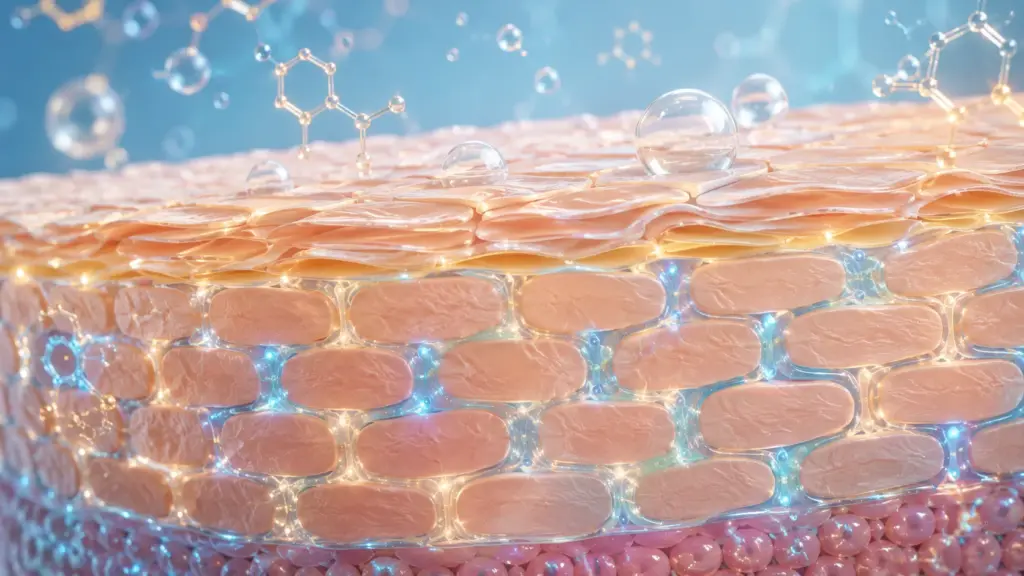
To understand why less is truly more, we have to look at the biological blueprint of the skin barrier, scientifically known as the stratum corneum. Think of this outermost layer as a brick-and-mortar structure. The “bricks” are your skin cells (corneocytes), and the “mortar” is a complex intercellular lipid matrix composed of essential fatty acids, cholesterol, and ceramides. This lipid shield has two crucial jobs: keeping vital moisture locked in and keeping environmental irritants, pathogens, and pollutants out.
When you flood your skin with conflicting active ingredients, you trigger micro-inflammation and disrupt the delicate pH balance of this acid mantle. For instance, layering low-pH exfoliating acids with high-percentage actives can destabilize the lipid matrix, causing microscopic tears in your skin’s protective shield. Once this shield is compromised, Transepidermal Water Loss (TEWL) skyrockets, leading to that deep, parched dehydration that no amount of superficial hyaluronic acid can fix.
Implementing a strategic skinimalism guide isn’t just about skipping steps to save money; it is a scientifically backed intervention designed to minimize the chemical burden on your skin cells, lowering cellular stress and allowing your skin’s natural cellular turnover and regenerative processes to take the lead. To understand how to safely transition your skin during this sensitive phase without triggering purging, you can read my comprehensive breakdown on how to structure a personalized K-beauty routine for sensitive skin.
3. The Solution: The Minimalist Trinity for Rapid Barrier Recovery
To rescue my complexion from the brink of burnout, I completely ghosted my intricate routine and stripped my daily protocol down to what dermatologists refer to as the “Minimalist Trinity.” These three gold-standard ingredients work synergistically to biochemically mimic, repair, and fortify a broken lipid barrier without introducing unnecessary fillers or synthetic irritants.
Core Ingredient 1: Panthenol (Pro-Vitamin B5)
- Biochemical Role: Deep Cellular Repair & Humectant
- Targeted Skin Benefit: Accelerates fibroblast proliferation, deeply hydrates, and stops the stinging sensation.
- Best Suited For: Damaged, flaky, peeling, or physically raw skin.
Core Ingredient 2: Centella Asiatica (Cica)
- Biochemical Role: Vascular Soothing & Anti-inflammatory
- Targeted Skin Benefit: Suppresses pro-inflammatory cytokines, cools down skin temperature, and reduces redness.
- Best Suited For: Chronic redness, rosacea-prone, and angry acne flares.
Core Ingredient 3: Ceramides (NP, AP, EOP)
- Biochemical Role: Intercellular Lipid Replenishment
- Targeted Skin Benefit: Fills the gaps in the lipid matrix, seals in moisture, and prevents TEWL.
- Best Suited For: Dry, tight, compromised, or environmentally stressed skin.
As detailed in the scientific breakdown above, you do not need to purchase a separate, expensive bottle for every single skin concern. The beauty of a streamlined K-Beauty philosophy lies in formulation efficiency. A single, well-formulated, high-quality barrier cream frequently contains this exact trinity of ingredients in a biocompatible delivery system. By choosing one comprehensive multi-tasking product instead of three separate serums, you drastically cut down the exposure to extra preservatives, ensuring your reactive skin cells are not overwhelmed by cosmetic fillers.
When sourcing products containing this holy grail trinity, look for “non-comedogenic” and “fragrance-free” emulsions rather than heavy, occlusive balms. A lightweight, gel-cream matrix allows Panthenol and Ceramides to penetrate efficiently without trapping sebum or inducing acne cosmetica in younger, oil-prone skin types.
According to clinical guidelines outlined by the American Academy of Dermatology (AAD), minimizing the number of topically applied products while focusing on clinically proven, biocompatible ingredients is the single most effective strategy to prevent allergic contact dermatitis and manage long-term skin sensitivity. In fact, the AAD emphasizes that the average cosmetic product contains dozens of potential allergens, and reducing a daily routine to fewer than four structural steps is the primary clinical recommendation for contact dermatitis recovery. You can review their official medical guidelines on skin sensitivity directly via the American Academy of Dermatology Official Website [https://www.aad.org]. When your skin is in a state of crisis, minimalism isn’t a trend—it’s medical common sense.
4. My Experience: 14 Days to a Calmer, More Resilient Skin Glow
Adopting this streamlined approach was admittedly terrifying at first. Like many skincare enthusiasts, I suffered from severe FOMO (Fear Of Missing Out) regarding the latest viral, high-potency ingredients trending on social media. I worried that by stripping my routine, my skin would lose its glow or break out further. However, the real-world results over a fortnight completely shifted my perspective on skincare mechanics.
- Days 1–3 (The Stabilization Phase): I cut out all active acids, retinol, and double-cleansing. My routine consisted solely of a pH-balanced, non-foaming cleanser, a soothing Centella toner, and a generous layer of a Panthenol-and-Ceramide infused barrier cream. By day three, the persistent, painful stinging sensation during my morning wash had completely vanished.
- Days 4–7 (The Redness Reduction): The angry, blotchy patches on my cheeks began to cool down. My skin texture no longer felt rough or sandpaper-y; instead, the surface began to feel noticeably softer and more uniform as the micro-inflammation subsided.
- Days 8–14 (The Resilient Glow-Up): By the end of two weeks, my skin barrier felt structurally resilient. The chronic tightness was gone, replaced by a plump, bouncy texture. Most surprisingly, the stubborn, tiny bumps along my jawline cleared up entirely—proving they weren’t acne breakouts at all, but rather a cry for help from an overworked, over-exfoliated face.
This intensive 14-day experiment taught me an invaluable lesson: quality formulation and biological respect will always beat sheer product quantity. Your skin doesn’t require a performative, multi-layered ritual to thrive; it demands a mindful, high-performance protocol that honors its natural biology and cellular pacing.
Final Verdict: Build Your Skin Barrier with Intention
True skinimalism is not about being lazy, nor is it about neglecting your self-care ritual; it is about practicing intentional, educated skincare. By filtering out the digital noise and centering your daily routine around scientifically proven powerhouses like Panthenol, Centella, and Ceramides, you are providing your sensitive skin with the structural stability it has been desperately craving. Think of this guide as your official professional permission slip to halt the exhausting cycle of product layering and finally start tracking real, sustainable results. Perform an honest audit of your vanity today, embrace the elegant philosophy of “less but better,” and watch your skin barrier transform into its healthiest, most radiant version yet.
Medical Disclaimer: This article is for informational and educational purposes only and does not substitute for professional medical advice, diagnosis, or treatment. Always seek the advice of your dermatologist or other qualified healthcare provider with any questions you may have regarding a medical skin condition.