
makeup by noon. As a skincare content creator who has spent years decoding over 500 INCI ingredient lists for hyper-reactive complexions, I know firsthand that navigating the world of UV protection when you have a compromised skin barrier feels like a cruel tradeoff between preventing premature aging and enduring daily discomfort. Many of us have been caught in that frustrating cycle—testing countless viral formulas only to end up with a ghostly white cast, stinging red eyes, or an overnight flare-up of contact dermatitis.
The Korean skincare industry has completely revolutionized how we approach UV filters. Protecting your delicate face no longer requires sacrificing your physical comfort. By shifting our focus from aesthetic, trendy packaging to clean, ingredient-focused formulation audits, we can demystify exactly why certain sunscreens trigger deep cellular inflammation, and how next-generation Korean formulations offer a genuinely tear-free solution.
1. The Core Issue: Why Traditional UV Protection Triggers Sensitive Skin
If you are dealing with a sensitive skin barrier, applying daily sun protection can often feel like a trigger for redness. The root cause of this persistent irritation rarely stems from a universal allergy to sunscreens; rather, it is a direct physiological response to outdated, high-penetration chemical filters.
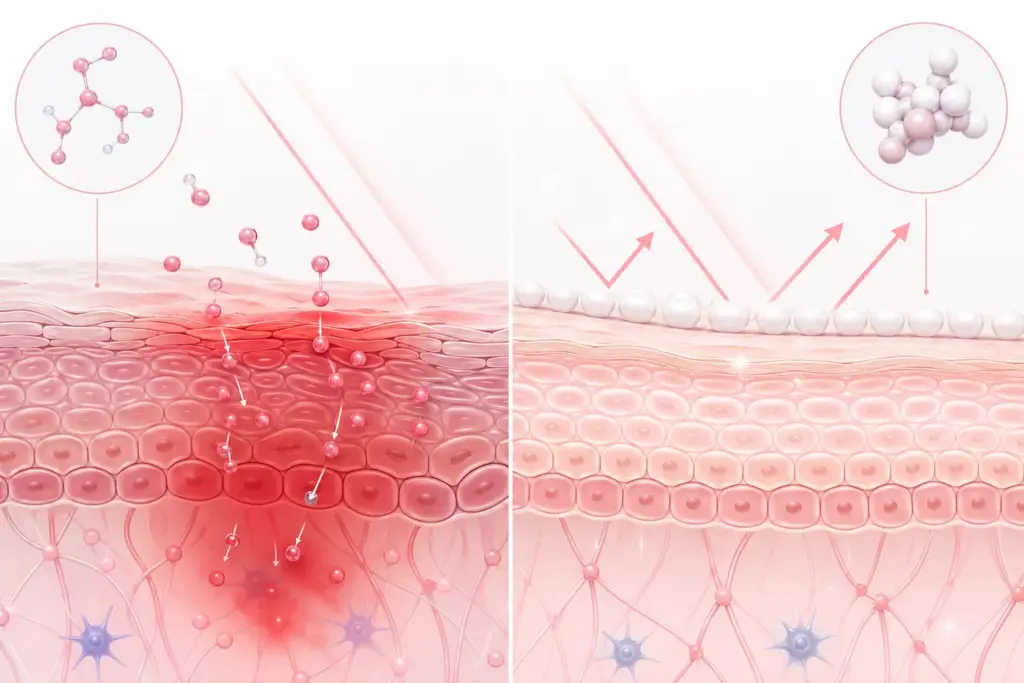
Traditional global formulations frequently rely on legacy organic chemical compounds. When these unstable molecules absorb UV light, they convert it into thermal energy directly on the skin’s surface. For an ultra-healthy skin barrier, this heat exchange is entirely unnoticeable. However, for those navigating chronic dehydration, rosacea, or an intrinsically compromised lipid barrier, this heat generation induces micro-inflammation. This leads to immediate flushing, increased transepidermal water loss, and that unbearable stinging sensation around the delicate eye area. Finding a truly non irritating k beauty sunscreen requires looking past clever marketing and understanding how modern filter mechanics shield your skin safely.
2. Advanced Dermatology: Physical Barriers vs. Next-Gen Molecular Filters
To eliminate the dreaded midday sunscreen cry, we must evaluate how different UV filters behave under a microscope.
Inorganic (Physical) Filters
Inorganic filters, primarily Zinc Oxide and Titanium Dioxide, sit seamlessly on top of the stratum corneum like microscopic mirrors to reflect and scatter UV radiation. Because these minerals do not penetrate the cellular matrix or enter the bloodstream, they remain the clinical baseline for highly reactive skin types. Zinc Oxide, in particular, doubles as an incredible soothing agent that actively calms surface redness. The historic drawback, however, has been purely aesthetic: traditional mineral formulations often leave a thick, chalky finish that is difficult to blend, causes pilling, and completely ruins a fresh, dewy makeup look.
Next-Generation Organic (Chemical) Filters
Modern Korean laboratories have solved this dilemma by completely shifting away from low-molecular-weight legacy filters. Instead, contemporary formulations utilize advanced, large-molecule organic filters. Advanced compounds such as Bis-Ethylhexyloxyphenol Methoxyphenyl Triazine (commonly known as Tinosorb S) and Methylene Bis-Benzotriazolyl Tetramethylbutylphenol (Tinosorb M) possess a significantly larger molecular weight.
These advanced filters are physically too large to penetrate the intercellular lipids of the skin barrier or migrate into your tear ducts. They absorb UV rays and dissipate them efficiently without generating localized surface heat. By choosing a sophisticated non irritating k beauty sunscreen that utilizes these hybrid or next-gen organic systems, you achieve the elegant, weightless, serum-like texture of a chemical lotion paired with the impeccable safety profile of a traditional mineral shield.
3. The Formula Audit: Decoding the INCI Matrix
When sourcing a non-sensitizing SPF, the ingredient list provides the ultimate clarity. The table below outlines the safety profiles and behavioral traits of the most common UV filters found in global and Korean sunscreens today.
| UV Filter Name | Filter Type | Sensitive Skin Compatibility | Ocular Irritation Risk | Mechanism and Skin Verdict |
| Zinc Oxide | Physical / Inorganic | Exceptional (5/5) | Extremely Low (1/5) | Gold Standard: Reflects UV rays while actively soothing active redness and inflammation. |
| Titanium Dioxide | Physical / Inorganic | High (5/5) | Extremely Low (1/5) | Excellent: Provides highly stable UVB protection; best paired with Zinc Oxide to minimize a white cast. |
| Tinosorb S / Tinosorb M | Next-Gen Organic | High (5/5) | Low (1/5) | The Modern Clean Standard: Large-molecule structure that remains on the skin surface without migrating into eyes. |
| Avobenzone | Legacy Organic | Moderate (3/5) | High (4/5) | Common Trigger: Highly unstable under sunlight; requires chemical stabilizers that frequently cause eye watering. |
| Oxybenzone | Legacy Organic | Low (1/5) | High (5/5) | Critical Red Flag: Known allergen with high bio-penetration; heavily avoided in clean K-Beauty formulations. |
Identifying Zinc Oxide or the Tinosorb family at the very top of your ingredient deck ensures a highly stable, non-reactive base. Conversely, if legacy chemical filters dominate the formula, it drastically increases the likelihood of contact irritation and midday ocular stinging.
Real-World Examples of Advanced K-Beauty Formulations
To translate this scientific data into your daily routine, keep an eye out for these two main categories of advanced Korean sunscreens currently dominating the global market:
- The Mineral-Based Calm: Look for daily physical sunscreens utilizing micro-particle Zinc Oxide paired with Heartleaf (Eoseongcho) or Centella Asiatica extract. These are widely popular in Seoul clinics for post-treatment care because they tone down redness instantly while creating a breathable, matte-fluid canvas.
- The Next-Gen Hybrids: Modern viral Korean sunscreens formulated with Tinosorb S and Panthenol offer a weightless, essence-like texture. They melt into the skin completely clear—making them perfect for deeper skin tones—while providing a radiant, glass-skin payoff with absolutely zero eye sting.
4. Clinical Application: A 3-Step Ritual for Reactive Barriers
Formulation is only one part of the equation; your daily application method heavily dictates how your skin tolerates an SPF throughout the day. Through clinical observation and personal trials with reactive skin, applying a dense layer of sunscreen directly onto an unprimed, raw face is a primary catalyst for cosmetic irritation.
Before diving into application mechanics, you must establish a resilient structural base. If you are unsure how to prep your moisture matrix, read my recent Ceramide vs Phytoceramide K Beauty Guide to learn how to lock in optimal intercellular lipids before sun exposure.
[Step 1: Bio-Identical Hydration] ➔ [Step 2: Dual micro-layering SPF] ➔ [Step 3: Orbital Bone Boundary]
Step 1: Establish a Bio-Identical Base
Before your sunscreen application, prime your skin with a lightweight, fragrance-free moisturizer rich in ceramides, cholesterol, and fatty acids. This reinforces your natural lipid matrix, creating a smooth, protective barrier that prevents any cosmetic surfactants from slipping into microscopic gaps in your skin.
Step 2: Utilize the Micro-Layering Technique
Instead of applying a single, heavy dollop of your non irritating k beauty sunscreen all at once, divide the recommended amount into two thin, distinct layers. Apply the first thin layer evenly across the face and allow it to set for 60 seconds. Follow directly with the second thin layer. This precise technique prevents the product from pooling in the fine lines around the eyes and migrating down into your tear ducts as you move throughout the day.
Step 3: Observe the Orbital Boundary and Avoid Volatile Oils
When working around your eyes, apply product strictly along the orbital bone rather than up to the lower lash line. The natural warmth of your skin will cause the product to settle slightly upward without seeping into the eyes. Furthermore, verify that your selected product is entirely free from synthetic fragrances and volatile essential oils—such as lavender, bergamot, or citrus—which act as primary triggers for contact dermatitis under active UV exposure.
5. The Restorative Step: Double Cleansing Without Barrier Stripping
Securing an ultra-gentle formula is only half the journey. If water-resistant UV filters and lipid-bound sebum are not thoroughly broken down at the end of the day, they will degrade overnight, clogging pores and causing morning irritation.
To ensure complete removal without compromising your skin barrier, implement a nightly double-cleansing method:
- Emulsifying Cleansing Oil or Balm: Begin with a mild, mineral-oil-free cleansing balm. Massage gently onto dry skin to dissolve the lipophilic structures of the UV filters and daily impurities.
- Low-pH Water-Based Cleanser: Follow with a soap-free, low-pH amino acid foaming cleanser to rinse away any remaining residue. This targeted approach cleanses the skin completely while leaving your delicate moisture barrier fully intact.
6. Frequently Asked Questions: Navigating Sensitive Eye Areas
Q: Should I apply sunscreen to my eyelids if they are highly reactive?
A. The skin on your eyelids is incredibly thin and highly vulnerable to photoaging and UV damage. However, if your skin is too reactive for direct topical application, do not force a product onto the lids. Instead, apply your sunscreen up to the orbital bone boundary and rely on verified UV-protective sunglasses as your primary line of defense for the immediate eye area.
Q: What is the clinical significance of the PA++++ metric?
A. While the SPF rating measures defense against UVB rays (which cause burning and surface redness), the East Asian PA system specifically measures protection against UVA rays. These are the deep-penetrating wavelengths responsible for collagen degradation, fine lines, and hyperpigmentation. According to the official sun safety guidelines maintained by the Skin Cancer Foundation, selecting a broad-spectrum formula with a high rating like PA++++ ensures maximum, long-term structural defense against deep cellular damage.
7. A Strategic Investment in Cellular Health
Selecting an advanced, thoughtfully formulated sunscreen is not merely an aesthetic choice for a flawless makeup base; it is a fundamental investment in your skin’s long-term cellular resilience. By prioritizing large-molecule organic filters, stable mineral bases like Zinc Oxide, and barrier-supportive botanical complexes, you can confidently maintain daily sun compliance while achieving a healthy, glowing complexion comfortably.
Disclaimer: The information provided in this guide is intended strictly for educational and informational purposes based on current cosmetic science. If you are experiencing severe, chronic allergic reactions, persistent eczema, or suspected contact dermatitis, please consult a board-certified dermatologist for a personalized medical assessment.