
PHAs vs AHAs BHAs is the ultimate ingredient showdown every sensitive skin girlie needs to understand before touching a chemical exfoliant this year. We’ve all been seduced by those high-strength “peeling solutions” that promise instant glow, only to end up with a face that feels like it’s on fire. As someone who spends my days auditing industrial components and repairing delicate tools, I’ve learned that using a harsh solvent on a fine gear is a recipe for disaster.
My own skin taught me the same lesson: I once used a 10% Glycolic Acid (AHA) and woke up with a red, stinging barrier that took weeks to heal. If you want that “Glass Skin” texture without the fiery regret, you need to understand the molecular audit of these acids.
At a Glance: Which Acid is Your Match?
- AHA: Best for sun-damaged, dry skin that needs deep renewal.
- BHA: Best for oily, acne-prone skin with clogged pores.
- PHA: Best for sensitive, reactive, or dehydrated skin types seeking a gentle glow.
1. The Problem: Why Traditional Acids Can Be Too “Heavy-Duty”
The struggle is real—you want to dissolve dead skin and clear out pores, but most AHAs and BHAs are simply too aggressive for reactive skin types. For my “dehydrated oily” community, these traditional acids often strip away the natural moisture barrier while trying to fix texture. In my professional experience, most of us are using a “heavy-duty wrench” (strong AHAs) when our skin actually needs a “precision screwdriver” (PHAs). This mismatch is why the PHAs vs AHAs BHAs debate is so crucial for your 2026 skincare strategy.
If your skin is currently feeling raw from over-exfoliation, pause everything and follow my 7-Day Skin Barrier Recovery Plan to reset your barrier before trying any actives.
2. The Science of PHAs vs AHAs BHAs: Why Molecule Size Matters
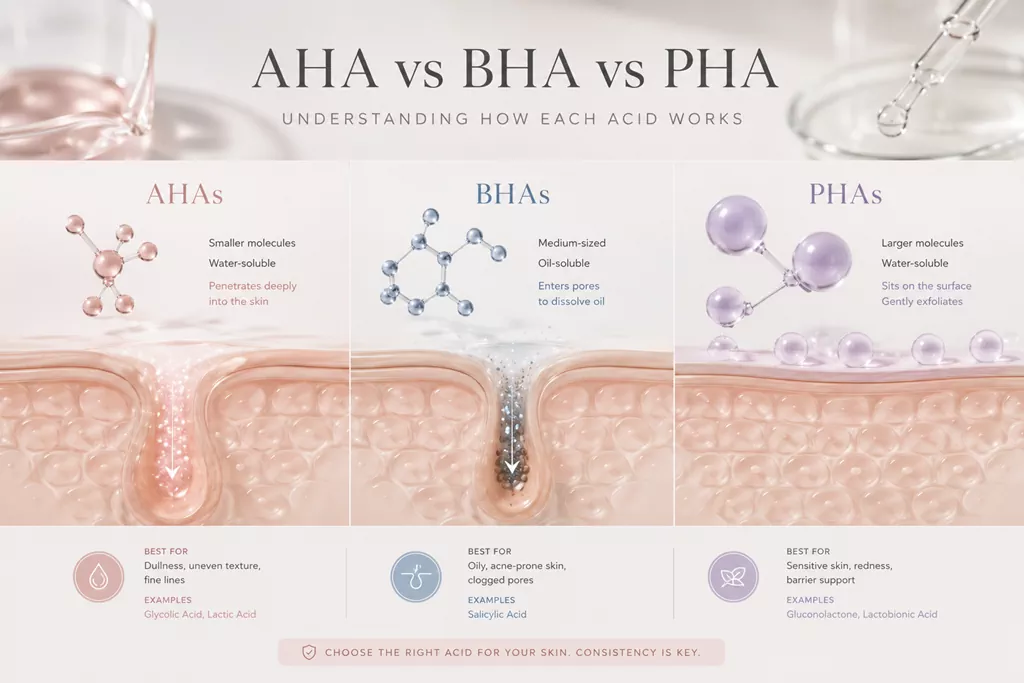
To truly master your routine, we have to audit the molecular size and penetration depth of PHAs vs AHAs BHAs. In the world of ingredient science, size definitely matters when it comes to irritation levels.
| Feature | AHAs (Alpha Hydroxy) | BHAs (Beta Hydroxy) | PHAs (Polyhydroxy) |
| Molecule Size | Small (Deep penetration) | Medium (Oil-soluble) | Large (Surface only) |
| Best Skin Type | Dry / Sun-damaged | Oily / Acne-prone | Sensitive / Reactive |
| Main Benefit | Intense Exfoliation | Pore Cleansing | Hydration + Gentle Glow |
| Irritation Risk | High | Moderate | Extremely Low |
| 2026 Trend | The Classic Powerhouse | The Acne Warrior | The Smart-Aging Hero |
Audit Analysis: Why PHAs are the “Gentle Giants”
The table above reveals the technical truth behind the PHAs vs AHAs BHAs hierarchy. When performing a PHAs vs AHAs BHAs technical audit, we see that PHAs (like Gluconolactone) have a much larger molecular structure compared to AHAs. Think of them like a high-quality lubricant that only works on the surface level; they dissolve dead skin cells without sneaking deep into your pores to cause a stinging reaction. Additionally, PHAs act as humectants, meaning they actually pull moisture into the skin while they exfoliate.
For the science-obsessed, you can check this clinical study on the efficacy of PHAs which proves they provide the same anti-aging benefits as AHAs without the inflammation.
3. Why PHAs vs AHAs BHAs Is the Secret to Your 2026 “Glass Skin” Glow-Up
Choosing between PHAs vs AHAs BHAs doesn’t have to be a guessing game if you prioritize “Smart Exfoliation.” In 2026, the trend is moving away from “no pain, no gain” and toward ingredient synergy. PHA is essentially the “Bakuchiol of acids”—it delivers results without the downtime.
The “Can I Mix This?” Audit: Ingredient Synergy
One of the most frequent questions I get from the 2030s community is about layering. Unlike their harsher cousins, PHAs play incredibly well with other actives:
- PHA + Vitamin C: Yes! PHA is gentle enough to prep your skin for Vitamin C without extra irritation.
- PHA + Copper Peptides: Yes! Unlike AHAs, which can break down copper peptides, PHAs are generally safe to layer, helping those anti-aging proteins absorb better.
The magic of PHAs is that they respect your skin’s integrity while boosting your other products. For a truly minimalist and effective routine, our Ultimate Skinimalism Guide highlights how to integrate gentle acids without cluttering your vanity. If you are already using a gentle anti-aging serum, like we discussed in the Retinol vs. Bakuchiol Verdict, adding a PHA toner is the perfect way to prep your skin. This combination ensures your skin is smooth enough for ingredients to absorb without being too raw to handle them.

4. FAQ: Navigating the PHAs vs AHAs BHAs Landscape
Navigating the PHAs vs AHAs BHAs landscape can be tricky, so let’s audit the most common concerns for the 2030s community.
Q1: Can I use PHA if I have active breakouts?
While PHA is great for surface texture, BHA is usually better for deep pore cleaning. However, if your skin is super sensitive, starting with a PHA is a safer way to ease into exfoliation.
Q2: Does PHA make my skin more sensitive to the sun?
Unlike AHAs, PHAs are generally non-photosensitizing. But as an auditor, I always say: don’t forget your SPF! Check my guide on Why Most Sunscreens Cause Breakouts to find your match.
Q3: How often should I exfoliate with PHAs?
Because they are so gentle, many can use them 3–4 times a week. Always listen to your skin’s “engine” and back off if you see any redness or tightness.
5. The Final Verdict: PHAs vs AHAs BHAs
For the 2030s girlies who want the results of a professional facial without the irritation, the winner in the PHAs vs AHAs BHAs battle is undoubtedly PHA. Still feeling a bit overwhelmed by the 2026 trends? I’ve consolidated all my findings into a Comprehensive K-Beauty Guide for Sensitive Skin to help you navigate your healing journey. Stop punishing your skin with harsh chemicals and start using the precision of PHA for a healthier, happier glow.
Medical Disclaimer: I am a professional repair technician and K-beauty ingredient auditor, but I am not a physician. This content is for educational purposes only. Always patch test and consult with a dermatologist before introducing new acids into your 2026 routine.
Ready to make the switch? Let’s audit your exfoliation routine in the comments below!